
Every part of this book is a love letter to transness, to trans people, and to the magic of gender exploration. My dearest hope is that you, reader, will fall a little more in love with yourself, your community, and your transcestors as you conduct or experience these rituals. No matter what is going on when this book finds its way to you, I most sincerely hope that you are finding the magic of your own authenticity and the bolstering strength of hope. And above all, always, lean into that trans audacity. The world desperately needs it
***
It was March when we gathered on the beach, a group of twenty or so folks who were all coming to that place at that time to release names, pro- nouns, or outdated understandings of ourselves that no longer served us. I designed the ritual for that exact time and place—the beach is, after all, a transitional space where many elements come together, mingle, and separate again. We gathered stones along the shore, then I passed out chalk that folks could use to write on the stones whatever they wished to release. As a group we allowed ourselves to recollect all the beauty, all the good that we had experienced with that name, pronoun, or identity. Even if it no longer resonated, it had been with us through some signifi- cant parts of our lives, and that was worth honoring.
With that sense of gratitude and honor, we released those stones to the Pacific, knowing that the chalk would wash away in the waves. Newly unburdened, we each called in what we claimed instead—new names, new pronouns, new ways of being our current, whole, and authentic selves. The folks who attended that day were not of any uniform type or identity. Some released their stones gently, allowing the tides to lap them away. Others hurled their rocks as hard as they could. Some danced along the shoreline, laughed, cried, hugged others. Regardless of why we were there and what we were releasing, each of us left that space changed. We were, each of us, changed by the power of ritual.
***
Gender rituals are a powerful form of medicine. In the past I’ve strug- gled to talk openly of rituals—their importance, their power, their potential—because I fear that I may sound hyperbolic. In my expe- rience as a gender doula, I have designed and held many rituals for folks—sometimes writing the rituals for a client to do privately, some- times officiating for a group or a community, and sometimes con- ducting the ritual in private for a single person, together in person or through the magic of the internet. Regardless of whether the ritual was on the beach, in a hotel room, in the desert, or on a video call, it was beautiful, intense, powerful beyond words. In gender ritual, I have watched folks peel back layers of trauma. I have watched them find love or connection with their body after assuming those avenues were forever closed. I have watched folks resource themselves enough to enter the deep underworld journey of surgery, or bring their community around them to affirm their new name and pronouns. To hold ritual space is to constantly tread in the liminal spaces—the space between breaths, the space between life, death, and rebirth, the space between our bodies when we hold one another, the underworld.
***
[…]when I felt spirituality calling to me, I was lost. I wasn’t going to commit to an organized religion—I had way too much religious trauma for that. While a lot of what resonated with me landed in the realm of pagan belief systems, most of them were blatantly steal- ing ideas from Indigenous or Asian cultures, or were thinly veiled ver- sions of white supremacy, or were far too organized for my comfort. Eventually, in my desperation to root into something that didn’t com- promise my values or activate my trauma, I asked myself, “What do you know to be true?” The answer that I eventually arrived on was transness and queerness. Thus began my ongoing journey of creating my own spiritual prac- tice, rooted in what I call the sacred knowledges of transness. Some of the rituals of this spirituality are very common—cutting or grow- ing your hair into something that feels daring and unexpected, taking an HRT shot or pill, purging your wardrobe of clothes that no longer resonate with you, sacrificing parts of your body on the altar of your authentic embodiment, taking a new name, new pronouns—but are not always considered rituals. They should be. As I moved through my own healing path, I received my calling to become a gender doula. In this role, I have heard countless folks say, in one way or another, “This feels so momentous, but the people around me are treating it like it’s no big deal. I know they want to be supportive, and I don’t want people to question me or be mean about it, but it is a big deal. I want someone to treat it like a big deal.” This, to me, represents the hunger for ritual. Having a loved one act like you don’t understand the gravity of gender exploration or transition can be deeply harmful and painful. But when everyone around you more or less just says, “You’re transitioning? That’s fine,” it can leave you feeling empty. The fact is, we’re all hungry for ritual. Without ritual we just slide from one part of life to the next. Without ritual it’s easy to lose the thread on what is important, what matters, that we matter, that our paths matter. Ritual isn’t about making a big deal over every little thing (though, honestly, almost every aspect of transition and transness are big deals). Rather, it’s about honoring the importance of something in our lives. Through ritual, transition can be honored and celebrated for the sacred process that it is in a way that is life-affirming, identity-af- firming, and crucially, community-affirming.
***
Ritual is potent, in my opinion, regardless of your belief system. Ritual is a technology available to all humans and to other animals as well. Famously, elephants, dolphins, crows, magpies, and others display ritual behaviors. There are likely countless rituals in the animal world that humans simply don’t have the knowledge or the tools to properly observe. Ritual is ancient and primal, something that we return to again and again and that we see evidence for across time and space, wherever life exists.
***
When I first started T, I had a story that I couldn’t possibly claim a male identity. At that point I had identified as nonbinary/masculine for years, but always shied away from saying I was male or even implying it. If I thought about claiming a male identity, I felt a massive cringe in my body, because my story was that I was a liar, simply trying to appropriate an identity that didn’t belong to me. My story was that I was just an annoying person who wanted all the benefits of being a man but who categorically was not. I wanted to take T because everything in my body was screaming for it, but that story was powerful, and even as I went in to the doctor for my prescription, I was terrified.
It wasn’t until I reckoned with the fact that I deeply loved everything happening in my body as a result of T that I was able to embrace my maleness, and it wasn’t until I embraced my male identity and affirmed my masculinity that I was able to lean more fully into a more gender-expansive identity and aesthetic, but that’s a story for another time. The point is, the stories that you have in your body don’t have to be negative, but when they are, they can be very powerful and very controlling.
In the tarot, this dynamic would be associated with the Devil card from the major arcana. The Devil is, even in most gentle decks, a frightening image. There’s usually a big scary monster and some people in chains, or some variation of that imagery. The funny thing about the Devil is that the archetype often reflects the ways that we put ourselves into what I like to call “un-sexy bondage.” We do this by constraining ourselves unnecessarily with stories about how we are bad, or inadequate, or unlovable, or any number of painful things. These stories are not true, but they are powerful, and as long as they control us, we have very little access to our power.
But the story of the Devil doesn’t end there. Often the most frightening thing we can do is truly face those stories and dismantle them. If you’ve been in chains long enough, freedom starts to feel like danger, and facing that head-on starts to feel like a fool’s errand. In the same way that the chains are actually stories that we hold about ourselves, the monster is the inflated danger we’ve convinced ourselves of. It is the worst-case scenario, the anxiety spiral, the unfiltered fear of rejection. When we steel ourselves and face that fear, it often evaporates before us, allowing us to experience true liberation. Does this sound familiar? Do you know what your stories are? If you’re struggling to identify them, start paying close attention to your actions and your reasons for those actions. Do you stop yourself from going for opportunities that you really want? Are you telling yourself that you aren’t trans enough? Does your imposter syndrome pop up in other areas of your life? This ritual is one that you can start right now, but you may need to repeat again and again. I’ve done rituals like this over and over again, addressing various nuances and depths of a specific challenge. For particularly sticky stories, I’ve done an entire lunar cycle of ritual like this. For others, it’s been one-and-done. For challenging topics, I have come back to this ritual in various iterations and varieties again and again for literal years. Only you will know what you need.
***
There’s a sort of gorgeous audacity to being trans, and living into that audacity in one area (identity) can open you up to expressing it in all sorts of other areas of your life. It reminds me of The Fool card in the tarot. In the traditional decks illustrated by Pamela Colman Smith, The Fool is depicted as a person happily traipsing toward what looks like the edge of a cliff, a little dog dancing up beside them. The person has a little bundle on a stick, much like the ones I used to tie onto sticks when I pretended to run away from home as a kid. They hold a flower in their other hand, head lifted to the heavens, a sunny sky behind them.
The Fool represents a leap of faith. They represent limitless potential, the moment before you move toward some unknown end. To me, The Fool can be a gorgeous representation of the moment when you stop overthinking something and just allow yourself to go toward it wholeheartedly. To everyone around you, it might look like you’re stepping off a cliff. But the wisdom of The Fool is knowing that no matter what comes after that step, they have all that they need to fly.
I don’t know what the world will be like when you read this, but as I am writing it, it is easy to feel that things are quite bleak. The attacks on trans people have reached a fever pitch, and there’s no sign that they are slowing or stopping. The world seems to be hurtling toward multiple disasters, and the term “meta-crisis” has become common in the general parlance. To hold hope, to build community, to explore or transition your gender in these times feels like the ultimate act of audacity. Yet trans audacity is exactly what we need to meet this moment. This space where I am sitting and sipping an iced coffee and writing my little trans book exists only because of the audacity of one trans person and the support of their community. This book, written and published as fascism rises and transphobia proliferates, exists only because of the audacity of a trans person, a trans editor, and a publisher that refuses to comply in advance. Every single person who chooses to question, explore, or transition their gender is throwing themself off the cliff edge of this society’s obsession with control, dominance, and power-over. Those who take that leap find their own ability to fly.
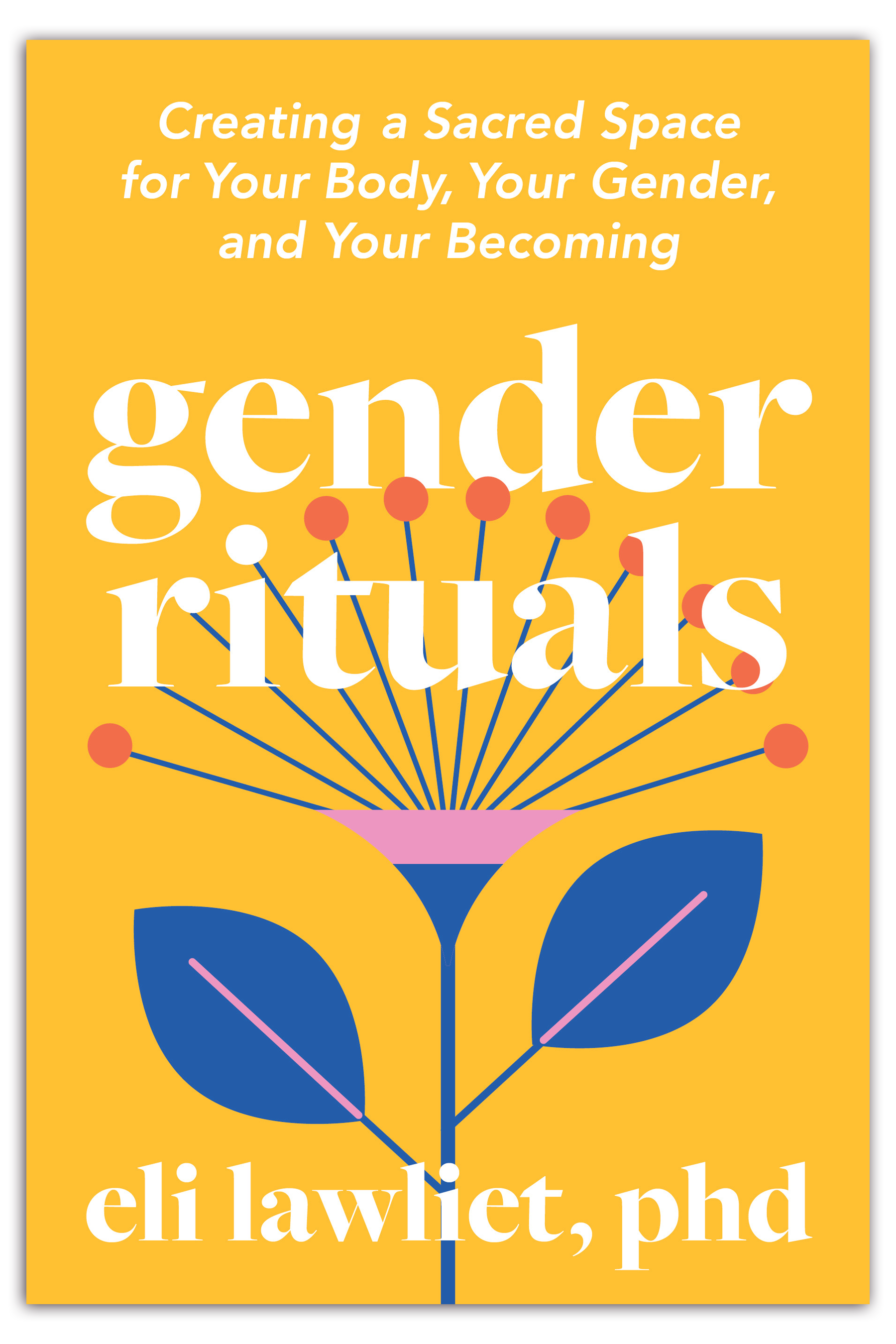
Pre-order your copy of gender rituals
Alternative places to pre-order: